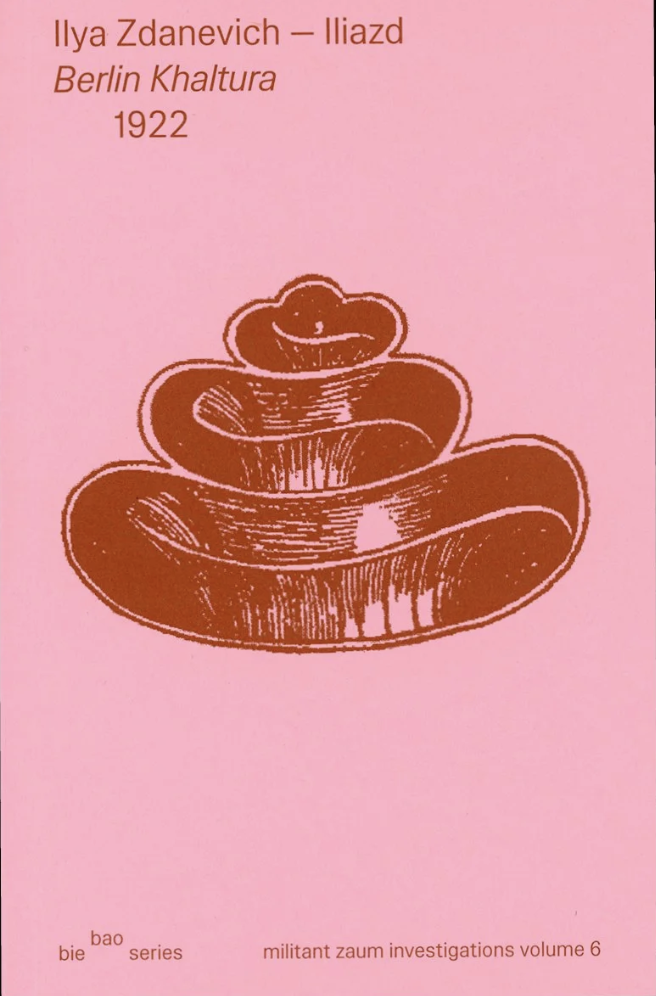
The sixth volume of the "bie bao" series revolves around Ilya Zdanevich’s account of his visit to Berlin at the end of 1922. The report offers a scathing takedown of Russian writers whom he accuses of commodifying and watering down the avant-garde discoveries. Zdanevich dismisses these opportunist writers as ‘khaltura’ writers — using a re-emerged Russian word designating hackwork, sloppiness, or simply kitsch art. Fascinating to anyone interested in the fate of the avant-garde in exile, Zdanevich Berlin’s report is translated and introduced by Roman Utkin, the author of a monograph on Russian Culture in Weimar Berlin.
The volume also includes letters sent by Viktor Shklovsky to Zdanevich, whom he subsequently hosted in Berlin. Translated and introduced by Jyrki Siukonen, these documents offer a glimpse into the many roads taken by the postrevolutionary avant-garde in Western Europe.
Alongside these texts, this volume also presents Zdanevich’s 1914 words-in-freedom poem gaROland. Translated and introduced by the poet Eugene Ostashevsky, the poem is dedicated to the aviator Roland Garros and marks Zdanevich’s initiation into Futurist poetry.
The sixth volume of the "bie bao" series revolves around Ilya Zdanevich’s account of his visit to Berlin at the end of 1922. The report offers a scathing takedown of Russian writers whom he accuses of commodifying and watering down the avant-garde discoveries. Zdanevich dismisses these opportunist writers as ‘khaltura’ writers — using a re-emerged Russian word designating hackwork, sloppiness, or simply kitsch art. Fascinating to anyone interested in the fate of the avant-garde in exile, Zdanevich Berlin’s report is translated and introduced by Roman Utkin, the author of a monograph on Russian Culture in Weimar Berlin.
The volume also includes letters sent by Viktor Shklovsky to Zdanevich, whom he subsequently hosted in Berlin. Translated and introduced by Jyrki Siukonen, these documents offer a glimpse into the many roads taken by the postrevolutionary avant-garde in Western Europe.
Alongside these texts, this volume also presents Zdanevich’s 1914 words-in-freedom poem gaROland. Translated and introduced by the poet Eugene Ostashevsky, the poem is dedicated to the aviator Roland Garros and marks Zdanevich’s initiation into Futurist poetry.